Jul 24, 2024 ·
Engineering One-Vote Guarantees in Django
A one-vote rule is only as strong as the last layer that can reject a duplicate write. In this Django voting system, that layer is the database constraint, while the surrounding audit and telemetry model creates a deliberate privacy tradeoff.
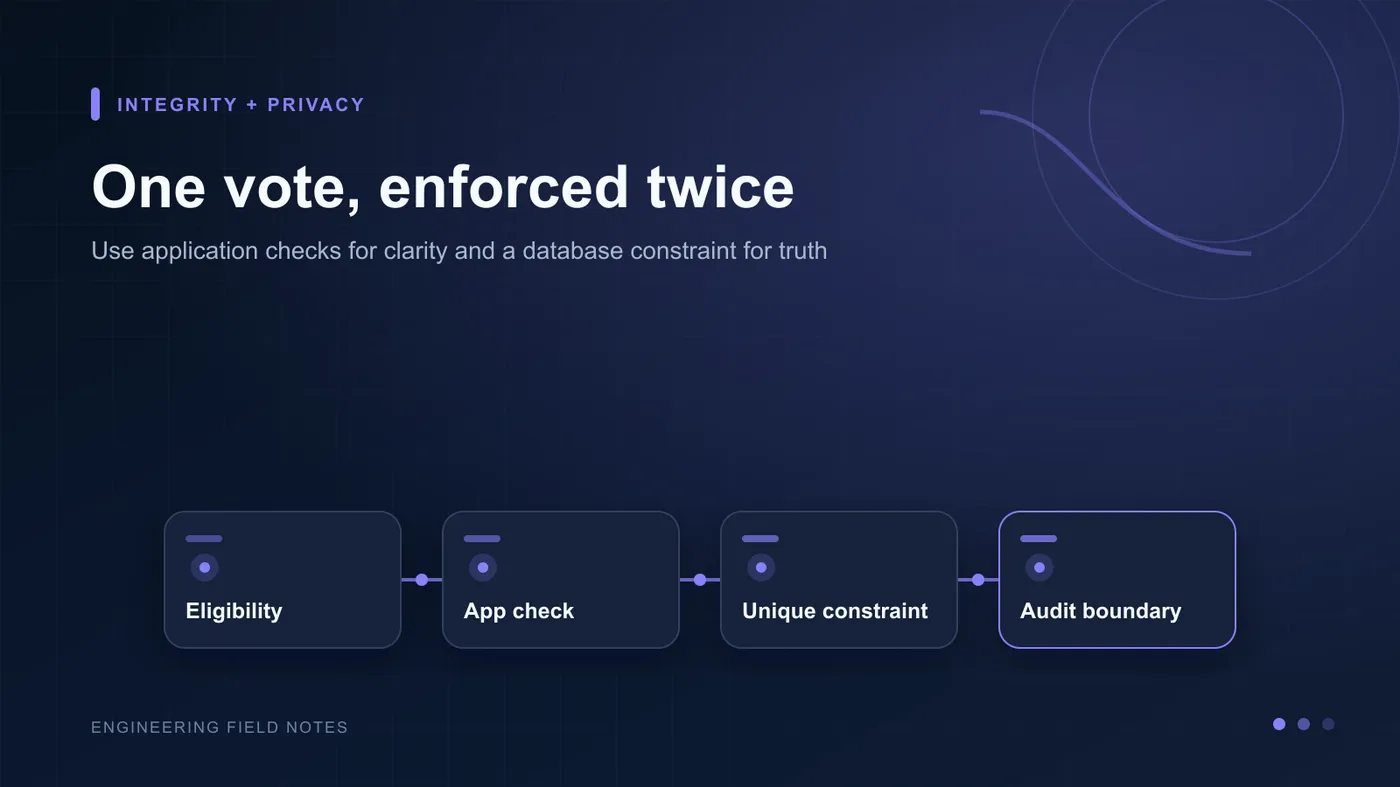
A voting workflow should not rely on a disabled button or a polite application check to enforce one ballot per voter. Those controls help the interface, but the final authority has to be the layer that sees concurrent writes and can reject the second one.
This use case covers a Django voting backend built around that principle. The core one-vote guarantee came from a database uniqueness constraint across voter and election. The API translated duplicate writes into a stable product error. Around that invariant, the system recorded authentication, request metadata, audit history, live updates, and reporting data.
That combination improved traceability. It did not create cryptographic anonymity. A system can protect against duplicate votes and still store enough linked metadata to narrow ballot secrecy.
Project context
The system supported institutional elections with authenticated voters, candidate selections, accreditation state, audit records, and results. It needed to reject duplicate submissions, return a clear response, and leave an evidence trail for authorized administrators.
The central constraint was familiar: each voter should have no more than one ballot entry for a given election. The system also needed operational visibility. Administrators may need to understand whether a vote was accepted, whether authentication succeeded, or how online and offline totals were combined.
Those requirements pull in different directions. Integrity asks for strong write-time enforcement. Auditability asks for traceable records. Privacy asks for minimization and secrecy. This design favored database-backed integrity and operational traceability, while requiring plain disclosure that it was not a cryptographically anonymous voting system.
Put the invariant where races end
The one-vote rule belonged in the database because race conditions end there. Two requests can arrive close together. A browser can retry. A user can submit from multiple tabs. A browser-side check can be bypassed. An application-level lookup can pass twice before either write commits.
The database uniqueness rule prevents that class of failure by allowing only one election entry for the same voter and election. Django's UniqueConstraint maps this design into a database-backed constraint, and Django raises IntegrityError when the database rejects an invalid write.
The API still built selections, created the election entry, attached ballot data, recorded limited operational metadata, and updated surrounding workflow state. Those steps sat around the invariant.
That is the important architecture point for any voting workflow: application checks can improve flow, but the one-vote guarantee should survive retries, concurrency, and interface manipulation.
Convert rejection into a product response
A raw database exception is correct for the server and useless for a voter. The mutation converted the duplicate-write failure into a stable already-voted response. That shape kept the database as the referee while giving the frontend an error it could handle deliberately.
Transaction behavior is the subtle risk. Django's transaction model matters because a failed database write can affect the surrounding transaction state. In this implementation, the duplicate branch returned immediately after the election entry creation failed, so later workflow updates did not run for a duplicate submission.
The ordering still deserves tests. Related ballot rows were prepared before the election entry was created. Depending on transaction wrapping, a duplicate failure could require cleanup or rollback guarantees around earlier work. The safe claim is that the design placed the one-vote invariant in the database and translated the expected integrity failure into a product-level response.
A practical verification suite should submit the same voter and election twice, including near-concurrent requests, then assert that only one election entry exists, the duplicate request returns the expected product error, and downstream side effects did not run twice.
Accreditation is secondary state
After a successful vote, the system marked the voter's accreditation as having voted. That was useful. It could simplify the interface, help administrators see progress, and support reporting.
It should not be treated as the root guarantee. Accreditation state is application state. It can drift if a write fails halfway, if an import path behaves differently, or if a maintenance task updates it incorrectly. The stronger invariant is the constrained ballot entry.
The hierarchy was clear:
- The database constraint rejected a second election entry for the same voter and election.
- The API converted the duplicate write into a stable frontend error.
- Accreditation state recorded the successful voting outcome for product workflows.
- Broadcasts and analytics described activity after the accepted write.
That hierarchy keeps each layer honest. A frontend can hide the vote button after accreditation changes, but the backend must still reject another submission. A dashboard can display progress, but results should be grounded in ballot entries and aggregation rules.
Traceability is not anonymity
The system stored more than selections. It could record voter-linked ballot records, authentication history, operational request metadata, device context, actor context, election context, and structured audit changes. Reporting combined result counts with participation and device analytics.
That level of traceability can be appropriate for some institutional elections. It helps administrators investigate suspicious activity, explain why a ballot was accepted, and reconcile participation.
It also narrows secrecy. A voter-linked ballot record plus request metadata and authentication history should not be described as anonymous voting. NIST's desirable voting-system properties separate secrecy, auditability, and integrity for a reason. The EAC Voluntary Voting System Guidelines also treat private and independent voting as a property that must be deliberately designed, tested, and protected.
The safeguard is disclosure and minimization. Every captured field should have a reason, retention rule, access rule, and disclosure rule. If request or device metadata is not needed for the audit obligation, it should not be collected by default. If it is needed, the documentation should state the privacy tradeoff directly.
Audit signals need explicit coverage
Django signals can make audit coverage easier to add. They can also make it harder to see. Django's own signal documentation warns that signals can make code harder to understand and debug, which is especially relevant when audit behavior becomes part of an election evidence trail.
The design used signals to write audit entries for multiple election-related objects. That was a reasonable way to centralize coverage, but it needed explicit tests and a visible audit map.
The operational questions are concrete:
- Which actions create audit rows?
- Which bulk operations bypass signal behavior?
- Which audit rows include actor context?
- What happens if audit writing fails?
Audit should be tested like an API contract. Critical voting actions should assert the expected audit row exists with the correct election, object, actor, and change data.
Results across online and offline channels
The reporting layer combined online and offline votes while counting by position and candidate. That shape is useful for elections that are not fully digital, but it raises a duplicate-vote question across channels.
The examined constraint protected ballot entries by voter and election. If offline participation enters through the same constrained model, the same invariant can protect the combined path. If offline results can be imported through a separate path, the system needs equivalent safeguards there too.
The safe framing is that the results layer combined online and offline counts while the one-vote guarantee was proven for the constrained ballot-entry path. A complete certification claim would need more evidence: constraints on import paths, reconciliation reports, validation rules, and tests proving that one voter cannot appear once online and once offline for the same election.
What changed
The system made the core integrity rule enforceable under concurrency. Duplicate votes were rejected at the database layer, and the API returned a predictable error. Accreditation and live updates supported the product experience without becoming the authority.
The design also made the privacy tradeoff visible. Audit records, operational metadata, authentication history, and voter-linked ballot data strengthened traceability but narrowed secrecy.
Where this pattern applies
This pattern applies to Django workflows where each participant may submit once per event, assessment, election, review, or controlled process. The domain may change, but the invariant stays the same: enforce uniqueness at the database layer, translate integrity failures into stable product errors, and treat audit metadata as a deliberate privacy decision.
For similar election or governance systems, start with the invariant. Make duplicate submission impossible in the database, test it under retries and concurrency, then decide how little metadata you can keep while still meeting the audit obligation.